Monkeys are fascinating animals. Their expressive faces, intelligence, playful movements, and human-like behavior make many people curious about keeping them at home. But before considering types of pet monkeys, it is important to understand that monkeys are wild primates, not domesticated animals like dogs or cats.
There are several small monkey species as pets that people commonly encounter in exotic-animal discussions, including marmosets, capuchins, squirrel monkeys, and spider monkeys. Each has different physical characteristics, social needs, diets, and behavior. More importantly, welfare organizations warn that their complex needs can be extremely difficult to meet in a private home.
So, what are the types of pet monkeys people usually ask about, and what should you know before viewing one as a companion?
Content
What Are the Different Types of Pet Monkeys?
When researching types of pet monkeys, you will often find small primates listed because their size can make them appear easier to manage. Common examples include marmosets, pygmy marmosets, capuchins, squirrel monkeys, and spider monkeys.
However, “small” does not mean “easy.” Primates need companionship from their own kind, stimulating environments, specialized diets, and appropriate veterinary care. They can also live for many years, making ownership a major long-term responsibility.
Here are some of the best-known species associated with the exotic-pet trade.
1. Common Marmoset
The common marmoset is one of the most recognizable small monkeys as pets. It has a tiny body, a long tail, distinctive facial markings, and prominent white ear tufts.
Common marmosets are highly social and live in family groups. Their natural diet includes tree sap and gum along with fruits, plants, insects, and other foods. They also use scent marking as part of their natural behavior.
Their small size can be misleading. The WWF classifies the common marmoset monkey as high risk as a pet because its housing, diet, social, and welfare requirements are extremely difficult to meet throughout its life.
This is an important lesson when comparing types of pet monkeys: appearance should never be the main factor in deciding whether an animal is suitable for private ownership.
2. Pygmy Marmoset
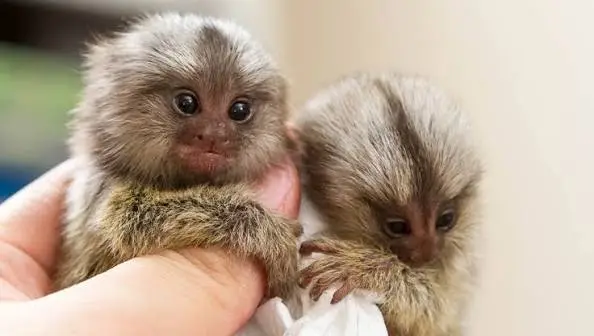
The pygmy marmoset is famous for being one of the world’s smallest monkeys. Its tiny body and delicate appearance have made it particularly popular in online discussions about exotic pets.
People sometimes confuse baby common marmosets with pygmy marmosets, especially when young animals are marketed using names such as “finger monkeys.” The RSPCA specifically warns that common marmoset babies have been mis-sold under such descriptions.
Although fascinating to observe, a pygmy marmoset still has the behavioral and social requirements of a wild primate. Its size does not remove the need for an appropriate social group, complex environment, specialized nutrition, and professional care.
3. Capuchin Monkey
Capuchins are among the most intelligent and well-known pet primates. Their ability to manipulate objects and solve problems can make them seem particularly appealing to people looking for an interactive exotic animal.
But that intelligence is exactly why they require so much stimulation. Capuchins naturally live in social groups, spend considerable time moving and foraging, and have complex behavioral needs. WWF rates capuchin monkeys as high risk and says their care, diet, and housing needs are extremely difficult to meet for their entire lives.
Their long lifespan also matters. Government evidence has recorded average lifespan figures for capuchins around 40 years, demonstrating that ownership can extend for decades.
4. Squirrel Monkey
Squirrel monkeys are another species frequently mentioned among types of pet monkeys. They are relatively small, active, and highly social.
Their energetic nature can be entertaining to watch, but it also creates significant environmental requirements. They need opportunities to move, climb, explore, and interact socially.
Research reviewed by Scottish government sources notes that squirrel monkeys can prefer energy-dense foods, creating nutritional challenges in captivity, while isolation can increase the risk of abnormal behaviors.
The WWF similarly considers common squirrel monkeys high-risk pets because their care and housing needs are difficult to satisfy in captivity.
5. Spider Monkey
Spider monkeys are considerably larger than marmosets and are built for life in trees. Their long limbs and prehensile tails help them move through their natural environment.
Their size, strength, intelligence, and social requirements make them particularly unsuitable for an ordinary household. Government evidence on primate welfare lists black-handed spider monkeys among species with lengthy lifespans, averaging around 30 years in the cited data.
For anyone researching what types of small monkeys for pets, spider monkeys are a good example of why “can be kept” and “should be kept” are two very different questions.
What Do Pet Monkeys Need?
The biggest mistake people can make when researching types of pet monkeys is focusing only on appearance or purchase price.
Primates require much more than food and a cage. Their needs can include:
- Companionship from compatible primates
- Large, stimulating environments
- Climbing and exploration opportunities
- Species-appropriate nutrition
- Mental enrichment
- Specialist veterinary care
- Appropriate temperature and environmental conditions
- Protection from household hazards
- Long-term financial and behavioral commitment
The RSPCA explains that primates need space, companions, mental stimulation, specialist diets, and specialist veterinary care. Human companionship cannot replace relationships with members of their own species.
A Real-Life Case Study: Joey the Capuchin
A documented case involving a capuchin named Joey shows what can happen when a primate’s needs are not properly met.
According to the RSPCA, Joey was taken from the wild in South America at only three months old and kept as a pet in a wardrobe-sized cage in a London flat for nine years. He received inadequate exercise, a poor diet, and insufficient sunlight. Eventually, he developed rickets, also known as metabolic bone disease, which caused irreversible disabilities. He was later rescued by Wild Futures Monkey Sanctuary.
Joey’s story is a powerful reminder that an animal can appear tame while still having needs that a normal household cannot satisfy.
Are Monkeys Good Pets?
If you are searching for the best types of pet monkeys, it is worth changing the question slightly: Which primate can actually have its welfare needs met in a private home?
For most people, the answer is none.
Monkeys are intelligent, social, active, and undomesticated. They can become aggressive as they mature, may bite or scratch, and can carry diseases that affect humans. Their social and environmental needs can also become increasingly difficult as they grow.
This does not mean monkeys are uninteresting animals. Quite the opposite. Their intelligence and social behavior are precisely what make them so remarkable. They are often better appreciated through ethical wildlife encounters, accredited zoos, sanctuaries, or conservation programs rather than private ownership.
Are Pet Monkeys Legal?
Another important consideration is legality. Laws concerning primate ownership vary significantly between countries, states, provinces, and municipalities.
For example, WWF notes that primate ownership is illegal or restricted in many U.S. states, while other jurisdictions have licensing or species-specific requirements.
Therefore, never assume that a monkey is legal to own simply because someone advertises one for sale. Anyone considering exotic-animal ownership should check current regulations with the appropriate local authorities and understand welfare requirements before making any decision.
Final Thoughts
Learning about types of pet monkeys can be fascinating because every species has unique adaptations, personalities, diets, and social structures. Marmosets and pygmy marmosets may be tiny, while capuchins, squirrel monkeys, and spider monkeys have very different physical and behavioral characteristics.
But the most important takeaway is that being interesting, intelligent, or small does not make a monkey a suitable household pet. These animals have complex needs developed over millions of years of evolution. Understanding those needs is far more valuable than simply asking which monkey looks the cutest.
If you love primates, learning about them, supporting responsible sanctuaries, and observing them in appropriate settings can be a much better way to appreciate these remarkable animals.
FAQs About Types of Pet Monkeys
What is the smallest monkey species?
The pygmy marmoset is the smallest monkey species, weighing only a few ounces and living mainly in the Amazon rainforest.
How long do pet monkeys live?
Depending on the species, pet monkeys can live for several decades, making ownership a long-term commitment.
Do monkeys bond with their owners?
Monkeys can form strong bonds with humans, but human interaction cannot replace the social relationships they need with their own species.
What do monkeys eat in captivity?
Monkey diets vary by species and may include fruits, vegetables, insects, leaves, gums, and specially formulated foods.
Do pet monkeys need companions?
Yes. Most primates are highly social and generally need compatible companions of their own species for proper social development.
Can monkeys be trained like dogs?
Monkeys can learn behaviors through training, but their intelligence and instincts make them very different from domesticated pets.
Why are monkeys considered exotic pets?
Monkeys are classified as exotic pets because they are wild, non-domesticated animals with specialized care and environmental needs.

Patrick Bravo takes readers on a heartwarming journey through the world of pet adoption. He champions shelter animals, shares inspiring rescue stories, and encourages families to open their hearts and homes to pets in need.